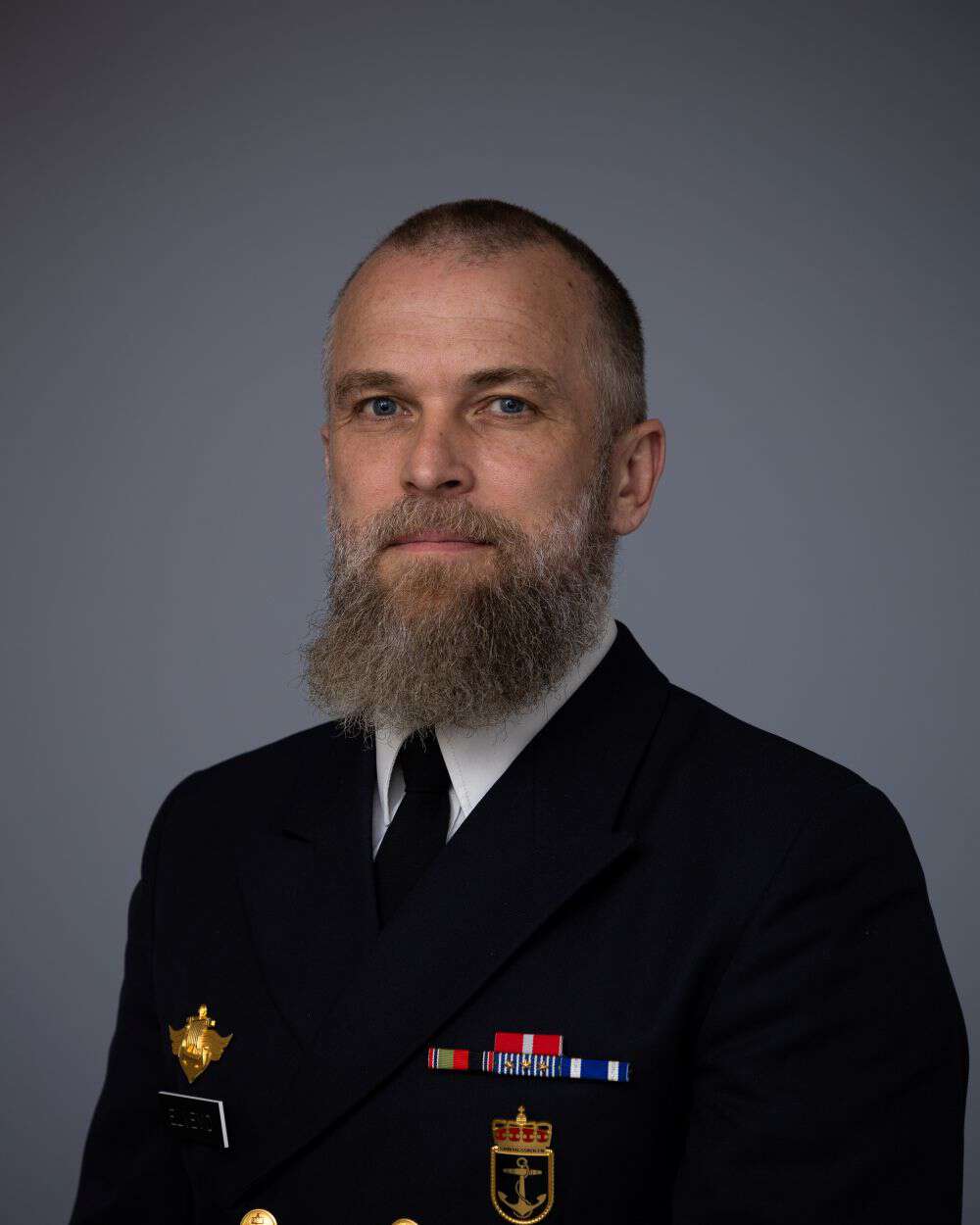
The trial lecture and the public defence are both open to the public and free to participate in person or online. Link will be published on the event web page https://www.forsvaret.no/forskning/arrangementer/disputation-lasse-elvemo.
For those who wants to participate in person, we ask you to register here: SIGN UP
Program
- 09.45–10.15 Registration and coffee
- 10.15–11.00 Trial lecture
- 11.00-12.15 Break
- 12.15–13.00 Public defence
- 13.00–13.15 Break
- 13.15–15.30 Public defence continues
- 15.30–17.00 Reception with tapas
Trial lecture title
To be published 12 November at 10:00.
Adjudication committee
- Professor Britta Linnea Gammelgaard, Aarhus University
- Professor Juha-Matti Lehtonen, National Defence University
- Professor Deodat Edward Mwesiumo, Molde University College
Chair of defence
Professor Harald Martin Hjelle, Molde University College
Supervisor
Background
The idea for the project grew out of my work at the Norwegian Naval Academy, where I saw how much military operations depend on supply chains that keep working under pressure. Around 2018, the security situation in Europe was getting worse, and the Norwegian armed forces were changing how they educate and train officers. Research on supply chain resilience was mostly about commercial companies, and little was known about what makes military supply chains hold up when they are disrupted. When Russia invaded Ukraine in 2022, the question became urgent. The project began in 2021 and was carried out in part with Ukrainian partners during the war.
Summary
What helps military supply chains hold up under pressure? That is the question Lasse Elvemo has examined. He surveyed logistics experts in a Norwegian exercise and in Ukraine’s armed forces during the war. The answers show that good working relations between leaders and staff go together with units having the freedom to act within the commander’s intent. This kind of mission command, in turn, goes together with units reacting quickly and recovering after disruptions. The pattern is the same in Norway and Ukraine, although the samples are small. The thesis shows that resilient supply chains depend on more than stockpiles, technology and structure. How people lead and work together under pressure also seems to matter.
For the field of logistics, the thesis suggests that leadership and command practice deserve a place next to structure and technology in research on supply chain resilience. It offers a model of how these pieces may fit together, which other researchers can test with larger samples and other types of data. For the armed forces, the results point to both practice and training that could benefit from including increased focus on mission command (intention based leadership and decentralized decision making). More broadly, the findings may be useful to any organization that has to keep working when things go wrong, such as hospitals, emergency services or companies with fragile supply lines. The study shows association, not proof of cause and effect, so the results are best read as a starting point for further research and practical testing.
Lasse Elvemo (48) comes from Bergen. He holds a Bachelor's in Military Logistics from the Norwegian Naval Academy in 2005 and a Master's degree from Norwegian Armed Forces and BI in 2013. His doctoral work has been financed by Norwegian Defence University College, Royal Norwegian Naval Academy, through a part time scholarship.