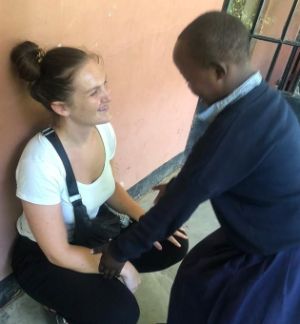
10th of January I left Norway heading to Tanzania together with a group of students for what was supposed to be a 3 month long stay at Patandi Teachers College. About 2 months in, our journey was cut short. A highly contagious virus was spreading across the world and had at this point reached our home country, to such an extent that we were advised to abort our program and head back home as the risk of closing country borders was growing too high.
It is now April 2020, and the world is turned upside down. There is an ongoing pandemic that leading epidemiologists tell us will be the most devastating threat to human kind since the Spanish flu in 1918, which killed as many as 50 million people.
I saw and learned a lot from my stay in Tanzania, but the thing that today worries me the most was something I thought would not worry me at all during the first part of our stay. As I was sitting on the plane back home I reflected up on the hygiene and sanitary issues I observed in Arusha. The suboptimal toilet routines, where children help each other as opposed to being assisted by an adult, resulting in fecal matter and urine spreading over the bathroom area is different from what we are used to back home. There are little possibilities to wash hands, and no soap. Children with small wounds did not use bandages to cover up their damaged skin, and therefore are more prone to wound complications. The basic hygienic state is not what we are used to in the western world. I am not used to seeing a lot of children with leaking and smelly wounds in Norway, in Tanzania I saw this a lot.
Convention on the rights of the child (CRC), Article 24 «States Parties recognize the right of the child to the enjoyment of the highest attainable standard of health and to facilities for the treatment of illness and rehabilitation of health. States Parties shall strive to ensure that no child is deprived of his or her right of access to such health care services». To comply with human rights, the hygienic and sanitary state in Tanzania is a problem in need of improvement.
As the world is facing the corona pandemic, hygiene is our most important weapon, it is therefore terrifying to think about the horrifying impact this virus can have on the community that, for 2 months was our home. At the same time, there is also an ongoing tuberculosis epidemic in Tanzania. The bacteria is transmitted from one person to another through inhalation of droplets, the same way as the corona virus. Tuberculosis is one of the top 10 causes of death, and the leading cause from a single infectious agent worldwide. Poor sanitation possibilities and lack of knowledge about how to maintain a good health through personal hygiene makes the people in Tanzania more exposed to infectious diseases, such as corona and tuberculosis.
I knew some of this before I left Norway, and was not shocked about what I saw. It is a problem that is in need of improvement. According to UN (United Nations) Sustainable Development Goal 6, access to water, sanitation and hygiene is a human right, and there is a lot going on already to try and improve the situation. We saw huge improvements already in movement during our stay, such as development of building standards and universal design. What is important is that People are not dying in flocks due to this hygiene problem today, although it is a serious problem. This was before the Covid-19 pandemic.
I am worried. Not for myself. Not for my family. Not for my country. I know we will survive until there is a vaccine. I am scared for all the people, and especially the children, that I learned to love during our 2 month stay in a country not as developed as my home country, Norway. I am scared that the vast majority of the people in the world today are living in similar conditions. Conditions that seem like made to make a pandemic virus thrive, grow, and spread. I strongly believe that the work that is going on to improve life quality for children with special needs is now more important than ever, in a time where the world faces a threat never seen before in the last 100 years. I am concerned many of these children will be left with a lower quality of care, as the people that care for them get sick or is forced to leave due to implications of the pandemic where they will have to care for themselves and their own families. I am deeply grateful for the work that every healthcare worker is currently doing all over the world, and I pray that we do not forget the poorest ones in the society, those with special needs, in a time when they need us the most. What comforts me is seeing that the children I got to know in Arusha are able to help themselves and each other way more than we are used to in Norway. This is both heartwarming and impressive to observe, and I believe there is a lot to learn from this back home.
Sincerely,
Pauline Bakkemyr Rakvåg